Introduction to Modern AI
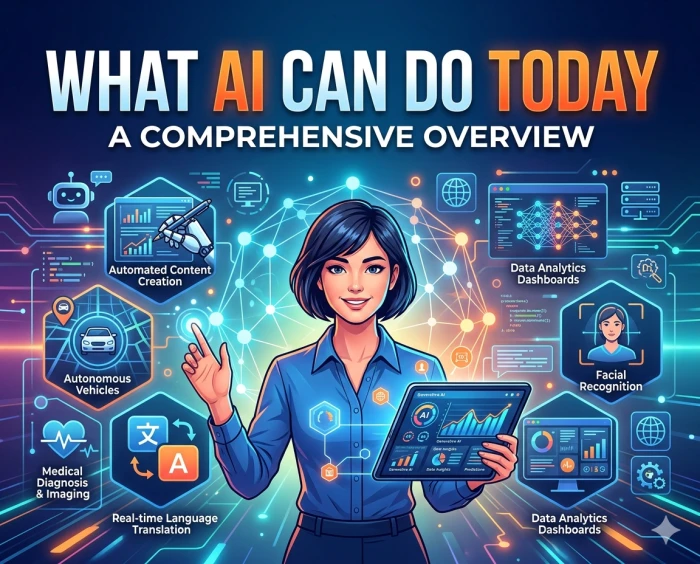
Artificial Intelligence (AI) has rapidly evolved from science fiction into a tangible force reshaping industries and daily life. This article provides an overview of the diverse capabilities AI possesses today, demonstrating its impact across various sectors.
Natural Language Processing (NLP)
NLP enables computers to understand, interpret, and generate human language. Its applications are widespread:
- Chatbots and Virtual Assistants: Providing customer service, answering questions, and offering personalized recommendations (e.g., Siri, Alexa, Google Assistant).
- Sentiment Analysis: Analyzing text to determine the emotional tone (positive, negative, neutral) used in market research, social media monitoring, and customer feedback analysis.
- Machine Translation: Automatically translating text from one language to another (e.g., Google Translate).
- Text Summarization: Condensing large amounts of text into shorter, more manageable summaries.
- Content Generation: Creating articles, blog posts, marketing copy, and other forms of written content.
- Spam Detection: Identifying and filtering out unwanted or malicious emails.
Computer Vision
Computer vision allows machines to "see" and interpret images and videos.
- Image Recognition: Identifying objects, people, places, and actions in images (e.g., facial recognition, object detection).
- Object Detection: Locating and identifying multiple objects within an image or video.
- Image Classification: Categorizing images into predefined classes (e.g., identifying different types of animals, cars, or plants).
- Medical Image Analysis: Assisting doctors in diagnosing diseases by analyzing medical images (e.g., X-rays, MRIs).
- Autonomous Vehicles: Enabling self-driving cars to perceive their surroundings and navigate safely.
- Quality Control: Inspecting products on assembly lines for defects.
Machine Learning (ML) and Deep Learning
Machine learning algorithms allow computers to learn from data without explicit programming. Deep learning, a subset of ML, uses artificial neural networks with multiple layers to analyze data with greater complexity.
- Predictive Analytics: Forecasting future outcomes based on historical data (e.g., sales forecasting, risk assessment, fraud detection).
- Recommendation Systems: Suggesting products, movies, music, or content based on user preferences (e.g., Netflix, Amazon, Spotify).
- Personalized Medicine: Tailoring medical treatments to individual patients based on their genetic makeup and other factors.
- Financial Modeling: Developing models to predict market trends, manage risk, and optimize investment strategies.
- Anomaly Detection: Identifying unusual patterns or outliers in data (e.g., detecting fraudulent transactions, identifying network intrusions).
Robotics and Automation
AI-powered robots and automated systems are transforming manufacturing, logistics, and other industries.
- Industrial Automation: Automating repetitive tasks in factories to improve efficiency and reduce costs.
- Warehouse Automation: Using robots to pick, pack, and ship orders in warehouses.
- Delivery Drones: Delivering packages and goods using autonomous drones.
- Surgical Robots: Assisting surgeons in performing complex procedures with greater precision.
- Exploration Robots: Exploring hazardous environments, such as deep sea or space.
Speech Recognition
Speech recognition technology converts spoken language into text.
- Voice Assistants: Interacting with devices using voice commands (e.g., controlling smart home devices, making phone calls).
- Dictation Software: Converting spoken words into written text for transcription and document creation.
- Call Center Automation: Using speech recognition to understand customer inquiries and route them to the appropriate agent.
- Accessibility Tools: Providing voice-controlled interfaces for people with disabilities.
AI in Healthcare
AI is revolutionizing healthcare by improving diagnosis, treatment, and patient care.
- Diagnosis and Disease Detection: Analyzing medical images and patient data to detect diseases earlier and more accurately.
- Drug Discovery: Accelerating the process of identifying and developing new drugs.
- Personalized Treatment Plans: Developing individualized treatment plans based on a patient's specific condition and genetic makeup.
- Remote Patient Monitoring: Monitoring patients' health remotely using wearable sensors and AI-powered analytics.
AI in Finance
AI is transforming the financial industry by improving efficiency, reducing risk, and enhancing customer service.
- Fraud Detection: Identifying and preventing fraudulent transactions in real time.
- Algorithmic Trading: Using AI algorithms to execute trades automatically and optimize investment strategies.
- Risk Management: Assessing and managing financial risks using AI-powered models.
- Personalized Financial Advice: Providing personalized financial advice to customers based on their individual needs and goals.
Ethical Considerations
As AI becomes more powerful, it is crucial to address the ethical implications of its use.
- Bias and Fairness: Ensuring that AI algorithms are not biased and do not discriminate against certain groups of people.
- Privacy: Protecting individuals' privacy when using AI to collect and analyze data.
- Job Displacement: Addressing the potential for AI to automate jobs and displace workers.
- Accountability: Determining who is responsible when AI systems make mistakes or cause harm.
Conclusion
AI's capabilities are rapidly expanding, transforming industries and impacting daily life. From NLP and computer vision to robotics and machine learning, AI is enabling new possibilities and solving complex problems. Understanding the current capabilities of AI is essential for navigating the future and harnessing its potential for good.